Thursday, July 7, 2011

Fiat 500 Coupé Zagato Concept

Fiat 500 Coupé Zagato Concept

The renowned Italian coachbuilder Zagato lists on its resume such stunning automotive sculptures as the Aston Martin DB4 GT Zagato, the Fiat 8V Coupé Elaborata, and the Alfa Romeo Giulia TZ. But design houses like Zagato have to pay the bills—especially when competitors like Giugiaro and Bertone are owned by Volkswagen and Fiat, respectively—and that can translate to cars that don’t sport such breathtaking designs. Case in point: The Fiat 500 Coupé Zagato concept. It debuted at the Geneva auto show, and we’d be fine if it stayed there.

To create this 2+2, Zagato lowered the standard 500’s rear roofline and raised the rear quarter panel, producing a spear-shaped window where the two lines intersect. The resulting shape of the C-pillar and rear window is reminiscent of the same section on the Hyundai Veloster. The company says that the design changes are intended to provide a coupe-like look for the three-door hatch. One nice touch, which preserves some noggin space inside, is the inclusion of Zagato's signature “double bubble” in the roof.

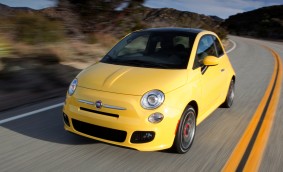
The 500 Zagato’s Pop Yellow exterior is matched by an interior outfitted in a mix of black and yellow. New 17-inch wheels, cross-drilled brake rotors, and burnished chrome trim complete the visual transformation.

Under the hood is Fiat’s turbocharged two-cylinder TwinAir engine, tweaked to produce more power than it does in any present application: 105 hp and 114 lb-ft of torque. In fact, in this state of tune the little mill actually surpasses the 1.4-liter four-banger in the U.S.-spec 500 by 4 hp and 16 lb-ft. Although Europeans have been receptive to the high-tech two-cylinder in the 500 so far, cost and public perception will bar it from American shores for the foreseeable future.

None of that matters, of course, unless the Coupé Zagato emerges from its concept cocoon and becomes a production model. Although Fiat is running much of Mini’s playbook with its 500, we don’t imagine that Zagato’s creation will be challenging Mini’s own squashed-roof coupe any time soon.

Wednesday, July 6, 2011

Fiat 500 by Gucci

Fiat 500 by Gucci

The ultra-extra-super-patriotic Harley-Davidson and Ford F-150 tie-in works, so why not something a little more, you know, Italian? Presenting the Fiat 500 by Gucci, which debuts at the Geneva auto show and highlights Italy’s association with high-end fashion. It also serves to commemorate Gucci’s 90th anniversary.

Now if the Harley pickup is a sloppy Joe with home fries, the 500 by Gucci is field greens with raspberry vinaigrette and a Parmesan crostini. Indeed, the Gucci touch does what it can to further emasculate the diminutive 500, which is hardly hairy-chested to begin with. Two color schemes are available: black with bright chrome details, and white with satin-finish chrome, both circumscribed by Gucci’s trademark green and red stripes below the window line. Lacey 16-inch wheels with color-coordinated insets feature Gucci’s interlocking-G logo on the center caps, while the B-pillar and liftgate are embellished with the word “Gucci” in a sassy cursive font.

Inside, the black leather seats with white “Guccissima” inserts are bisected by the Gucci stripe, which also appears on the seat belts, shifter, key fob, and carpets. And if that’s not enough, customers may further stuff the interior with a full line of “500 by Gucci” travel accessories, as well as a suitcase full of other goods, including track suits, driving gloves, bomber jackets, sunglasses, and, of course, a watch.

Fashion/car pairings are tough to get right; Lamborghini could barely pull it off when it partnered with equally outlandish Versace in 2006 for a limited run of the Murciélago LP640 Versace, and there also was 2008’s Hermès-treated Bugatti Veyron. Then again, at a price of €17,000, the 500 by Gucci is a fraction of a fraction of the cost of the aforementioned Lambo or Veyron, and roughly what the lunching-lady set drops in a Gucci boutique in one afternoon. It will become available in Europe this summer, and the rest of the world at the end of the year.

No word as to whether a copy was given to “Mouth Full of Golds” rapper Gucci Mane, but given his arrest late last year for reckless driving, his subsequent stay in a psychiatric hospital, and new ice-cream-cone facial tattoo, we doubt it.

Tuesday, July 5, 2011

2013 Fiat 500 EV

2013 Fiat 500 EV

What it is: An electric Fiat 500.

Why it matters: Fiat needs to prove it’s a forward-looking company, even if the 500 EV’s electric technology is essentially developed by Chrysler. Also, Fiat needs to give people another reason to buy a 500 besides styling if  it wants to keep the sales curve from plunging to the bottom, Smart Fortwo–like, after the cuteness fades.

Platform: The 500 skeleton, which is shared with the European Fiat Panda and Ford Ka, altered for electric drive and battery storage.

Powertrain: A 100-hp electric motor powered by lithium-ion batteries.

Competition: Regular Fiat 500, Nissan Leaf

What might go wrong: Customers will have to deal with range anxiety. And if governments stop supporting EVs with attractive subsidies, pure electrics might not stand a chance.

Estimated arrival and price: Chrysler has said 2012, but we figure 2013. Pricing should mirror the Leaf’s, which starts at $33,630 before incentives.

Monday, July 4, 2011

2012 Fiat 500C Convertible

2012 Fiat 500C Convertible

The second Fiat 500 model has hit America: The 500C, an open-air version of the relentlessly adorable three-door hatchback. Its beachhead is the New York auto show.

It’s not a true convertible, but more a mega-sunroof version in the spirit of the original Cinquecento. Here, the double-layer cloth top and glass rear window pile back on top of the small liftgate, leaving the roof rails in place; in a neat trick, the CHMSL integrated into the top’s trailing edge is still visible as part of the stack. The roof can be completely retracted at vehicle speeds of up to 50 mph—and slid back to the C-pillar up to 60 mph—so dropping the top need not delay arrival to your next bunga bunga party.

Much the Same

The Toluca, Mexico–assembled 500 Cabrio is only available in entry-level Pop and uplevel Lounge trims—there’s no Sport edition as with the hatch—making this one utterly about style. But beyond the unavailability of the Sport’s interior and exterior baubles, sportier seats, and invigorated steering and suspension, most everything else is regular 500. The C should then deliver the same driving experience, a nice balance between relaxed personality and eager-to-please handling.

Underhood you’ll find the 500 hatch’s single-overhead-cam 1.4-liter MultiAir four with the same 101 hp and 98 lb-ft of torque, bolted to the identical five-speed manual and six-speed automatic transmissions (the former has U.S.-specific ratios and the latter is an American-market exclusive). The 500C Pop is available with either transmission, while the Lounge is all automatic, all the time. Fuel economy is largely unchanged from the hatchback’s, with only the automatic’s highway rating dropping by 2 mpg. The 500C is expected to return 30/38 mpg with the manual and 27/32 with the automatic.

Curb weights for the 500C tick upward by about 50 pounds, which should put it over the 2500-pound mark on our scales. Blame the top mechanism and the reinforced crossmember in the windshield header; the latter requires a slightly longer windshield than the regular 500’s to, as Fiat puts it, “elegantly conceal” the bracing. The retractable roof has benefits for rear-seat passengers, who not only get the wind in their hair with it pulled back, but an additional 1.2 inches of headroom with it in place. The other notable numerical shift occurs in the cargo area, where the 500C’s tiny hatch raises to reveal just 5.4 cubic feet of storage, down from the regular car’s already-meager 9.5. At least access is easy, as the roof stack shifts out of the way when the liftgate is raised with the top retracted.

Any Way You Want It

The 500C still seats four and is as customizable as the three-door, with three top colors, 12 interior upholstery and trim combos, and 14 exterior paints. Further personalization through whimsical graphics is of course on the menu; put it all together, and Fiat says there are more than half a million possibilities. Voice-activated Bluetooth is standard, and it can power an optional dockable TomTom nav unit. Other available features include heated front seats, upgraded audio, leather, an auto-dimming rearview mirror, and a wind blocker, among other items. The 500C also gets four 15-inch wheel designs, one made of steel (with hubcaps) and three from aluminum.

Sunday, July 3, 2011

2012 Fiat 500 U.S.-Spec

2012 Fiat 500 U.S.-Spec

Fiat is reentering the U.S. market in a sector that is booming and the opposite of boring, and into which its infiltrator fits perfectly. Small-car segments are growing fast, and some of the most daring bodies in the business are among the smallest: the Nissan Juke and Cube, the Smart Fortwo, even stuff like the Ford Fiesta and upcoming Chevrolet Sonic and Spark ooze personality in a way few larger vehicles do. And, of course, the Fiat 500’s small, cute, and affordable approach is a close copy of the strategy that worked so well for Mini. If the 500 can match Mini’s average of about 40,000 U.S. sales a year, Fiat will be mighty pleased.

If you think you understand the Italians, consider the take of Roberto Giolito, the head of Fiat styling. He compares the original 500—or, in Italian, Cinquecento—to Bibendum, the Michelin spokesthing that, in his words, is “a fat man made from several tires.” He says this without a hint of irony and without the slightest consideration that a fat man made from tires might not be a good design goal for a car. It’s not just the original, either. He sees the same thing in the modern 500. We don’t quite see the same disarming heftiness, but have to admit that the car is cute.

More Colors than a Double Rainbow

It’s retro-adorable inside, too, where an option swaps out the black surrounds for the HVAC and stereo controls for white Bakelite-look plastic. Checking this box also whitens the steering wheel and column—including the windshield-wiper and blinker stalks—as well as the trim around the gauge cluster. It’s actually not a cluster, really, but rather one enormous gauge comprised of concentric circles. In the middle is a digital display reporting engine temperature, fuel level, date, time, and exterior temperature. Wrapped around that is the tach, and around that the speedo. In reference to John Madden’s Thanksgiving feast—which consists of a chicken stuffed inside a duck stuffed inside a turkey and is referred to as a “turducken”—one C/D staffer called the monster gauge a “speedtachen.” If it sounds confusing, it isn’t. And no matter what info you want, you always know where to look. As a bonus, although the 500 might need a lot of time to reach top speed, at redline in every gear, the tach needle points to 120 mph on the speedo. So it’s got that going for it.

We love the optional white accents, but they do highlight the fact that the rest of what surrounds occupants is an interior befitting a $16,000 car. Hard, hollow black plastic makes up the top of the dash, the door panels, and the center console. And we noticed not all of the segments of the digital clock were uniformly illuminated. That and the fact that the HVAC controls felt as if they might fall off in our hands might sound nit-picky, but we haven’t had similar gripes about any other car in years.

The basic interior design is complemented by a page taken directly from the Mini playbook. (Actually, Fiat hasn’t just stolen a page; it has lifted the entire book. Where’s the FIA investigation?) In addition to the 14 available interior trim colors, some 50 accessories are available at launch, from interior lighting kits and roof racks to a variety of exterior graphics. Fourteen exterior colors are available for the 500, including two reds, yellow, orange, two different browns, and two greens.

High Standards

Fiat is hoping to distinguish the 500 further with its equipment. The base trim level, the Pop, includes power windows, locks, and mirrors; seven airbags; air conditioning; and cruise control. It’s not a ton of stuff, but neither is the $15,995 price. The company expects most of the sales volume to come from the middle trim level, the 500 Sport. For $17,995, the Sport adds 16-inch wheels (in place of the Pop’s 15s), unique fascias front and rear, a Bose sound system, and red brake calipers. At the top of the line sits the Lounge, at $19,995. It adds a six-speed automatic, a fixed glass roof, an alarm, satellite radio, and a leather-wrapped steering wheel. On Pop and Sport models, the automatic is a $1000 option. For reference, Honda Fit base prices range from $15,850 to $19,990, and the Nissan Cube’s, from $15,070 to $21,970.

Saturday, July 2, 2011

Smart Forspeed Concept

Smart Forspeed Concept

Things are changing when 0-to-60 times proudly flaunted by auto manufacturers refer to reaching a speed in kilometers, rather than miles, per hour. Such is the case with Smart's Forspeed concept, which—as Daimler proudly informs us—reaches the equivalent of 37 mph in 5.5 seconds. This awesome performance is delivered by a 41-hp electric motor, and while the company doesn't provide a 0-to-60-mph figure, we are assured that this two-seater will accelerate all the way up to 75 mph. A push of a button adds another 7 hp, in case you are challenged to a race by any particularly muscular slugs.

This is not impressive by any standard, and we are more than a little surprised that Smart chose to name this concept Forspeed, which easily qualifies as the most absurd iteration of Smart's “Forwhatever” nomenclature to date. Here, the final “ED” in the name, which is written as ForspeED on the concept itself, is intended to reference Smart’s Fortwo Electric Drive; its powertrain is similar to this concept’s but the Fortwo ED is estimated to be a second slower to the 37-mph mark—the difference likely is due to the added weight of the production car’s roof. (The press release didn’t fill us in as to what the remaining “Forspe” part of the name refers.) In the Forspeed's defense, it will feel strong at step-off—for a few nanoseconds—thanks to the immediately available torque from the electric motor.

Electric cars without range-extending generators, of course, will be largely confined to urban areas, despite—or rather, because of—the fact that an "80-percent charge takes only 45 minutes," as the press release claims. That's slightly more time than an 80-percent refill of a gas tank takes. The Forspeed's range is claimed to be around 85 miles on a 100-percent charge. Some external solar cells help generate electricity as well, but only enough to power accessories or charge a phone.

Outside, the Forspeed provides a fresh interpretation of Smart's styling language. The body is soft and bulbous, giving an indication of the direction of future Smart design. The head- and taillights mirror each other, with two large LED rings and a round, white center section that doesn't illuminate. There is a teardrop motif to them, which reminds us of the last-generation Kia Picanto but is actually supposed to evoke raindrops on the windshield of an airplane.

In that vein, the Forspeed's windshield is styled to look like it belongs on a vintage propeller plane, and the gray strip evoking Smart's characteristic Tridion safety cell forms a roll bar behind the seats. A very similar motif was also used on another electric concept car, the Swiss-engineered Esoro E301 from 1992. Probably just a coincidence.

Esoro E301 concept
There is no roof on the Forspeed, so when rain threatens, the interior needs to be covered up with a tonneau cover. For driving alone in inclement weather, the passenger side can be covered by itself. There also are no external door handles; you must grab the interior door handles to open the car (and prepare for suspicious looks and possible questioning by the authorities).

The interior, painted white and green with brown leather elements, looks decidedly 1960s Italian. Two large pods house the speedometer on the left and an iPhone on the right. And the green shelf spreading across the width of the dashboard looks to have been inspired by the 1980 Fiat Panda.

Binz Crossblade
There is a historic example for this body concept: the Smart Fortwo–based Crossblade, 2000 of which were built starting in 2002 by coachbuilder Binz. That car proved to be virtually unsellable. And that's probably why Smart tells us right away that the Forspeed will remain a solitary prototype. We’ll see the first and last of it at the Geneva auto show.

Friday, July 1, 2011

Mini Rocketman Concept

Mini Rocketman Concept

Mini’s stand at the 2011 Geneva auto show is the launchpad for its slick little Rocketman, a concept car that evokes the spirit and packaging of the original Mini even more faithfully than the current Cooper. For one thing, at 11 feet, 3 inches long, the Rocketman is barely longer than its eensy forefather. Its width is closer to that of the new car than the old, but this is about as mini as a car can get while making room for four occupants.

Yes, four. Mini claims that the Rocketman’s reconfigurable cabin can be set up for two or three seats, or a 3+1 arrangement with, in Mini’s words, “an exceptionally efficient division of space” (read: everybody’s gonna hurt). That sounds like a challenge to us: second only to driving it, the most fun you could have in an original Mini—or contemporary Beetle or Fiat 500—was seeing how many friends you could stuff inside. Now we know that the Rocketman’s starting point is four.

Getting everybody in and out shouldn’t be too much of a challenge, however, thanks to double-hinged doors that move forward as they swing out. Once inside, those whose faces aren’t smashed against the windows might be able to see the central speedo, which incorporates 3D graphics. Rather than the tiny console-mounted joystick that controls the infotainment system in today’s Minis, a trackball on the steering wheel handles those functions in the Rocketman. Connectivity is facilitated by a removable control unit that can be hooked up to a home computer to program destination and contact information, as well as to manage music files. (And here we thought that cars were going to do that wirelessly. Hmm.)

Same Design Language, Lots of New Words

With its wraparound greenhouse and clamshell hood, the Rocketman is instantly recognizable as a Mini, although its design adds many new forms to the company’s vocabulary, including inverted-stirrup taillights (skateboarders might see them as grab handles), LED headlamps with bright halos, and a transparent roof through which the Union Jack–patterned roof structure is visible. The top half of the tailgate is hinged at the center of the roof and uses the diagonals of the Union Jack as cut lines, while the lower half slides out like a drawer, complete with an organizer. The 18-inch wheels are gorgeous, but positively show-car extreme in proportion to the body. As cool as it looks in the daylight, though, nighttime is showtime for the Rocketman, with lights tucked into the chrome beltline illuminating the interior, and much of the roof’s Union Jack outlined in white light strips.

Carbon fiber makes up much of the Rocketman’s structure, and it is visible in various places inside and out of the car—most notably the trailing edges of the front fenders. Mini isn’t saying what powers the Rocketman, but it claims that, thanks to the car’s low weight, average fuel consumption on the European combined cycle will be the equivalent of 78 mpg. All we know is that the single center-mount tailpipe is tiny, roughly the same caliber as a pea shooter.

If you’ve made it this far without humming Elton John’s “Rocketman,” you are stronger than we are. But since it’s already in our heads, we’ll indulge ourselves and paraphrase the song when we say we think it’s gonna be a long, long time/til touchdown brings [us] ‘round again to find… any car with all the Rocketman’s niftiness making it to production. In other words, don’t hold your breath for a lot of this stuff.

It is, however, worth noting that Mini has a strong history of putting its concepts on the road in some form, and Mini USA’s vice president, Jim McDowell, recently stated that an eighth Mini will be added to the lineup. (The currently known seven: hatch, convertible, and Clubman; Countryman and upcoming Paceman; and the imminent Roadster and Coupe.) If this is not that eighth model, it should be. There is much about the Rocketman that looks ready for takeoff.