Sunday, July 3, 2011

2012 Fiat 500 U.S.-Spec

2012 Fiat 500 U.S.-Spec

Fiat is reentering the U.S. market in a sector that is booming and the opposite of boring, and into which its infiltrator fits perfectly. Small-car segments are growing fast, and some of the most daring bodies in the business are among the smallest: the Nissan Juke and Cube, the Smart Fortwo, even stuff like the Ford Fiesta and upcoming Chevrolet Sonic and Spark ooze personality in a way few larger vehicles do. And, of course, the Fiat 500’s small, cute, and affordable approach is a close copy of the strategy that worked so well for Mini. If the 500 can match Mini’s average of about 40,000 U.S. sales a year, Fiat will be mighty pleased.
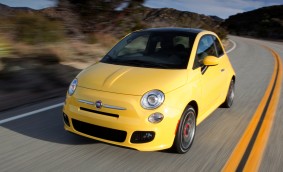
If you think you understand the Italians, consider the take of Roberto Giolito, the head of Fiat styling. He compares the original 500—or, in Italian, Cinquecento—to Bibendum, the Michelin spokesthing that, in his words, is “a fat man made from several tires.” He says this without a hint of irony and without the slightest consideration that a fat man made from tires might not be a good design goal for a car. It’s not just the original, either. He sees the same thing in the modern 500. We don’t quite see the same disarming heftiness, but have to admit that the car is cute.

More Colors than a Double Rainbow

It’s retro-adorable inside, too, where an option swaps out the black surrounds for the HVAC and stereo controls for white Bakelite-look plastic. Checking this box also whitens the steering wheel and column—including the windshield-wiper and blinker stalks—as well as the trim around the gauge cluster. It’s actually not a cluster, really, but rather one enormous gauge comprised of concentric circles. In the middle is a digital display reporting engine temperature, fuel level, date, time, and exterior temperature. Wrapped around that is the tach, and around that the speedo. In reference to John Madden’s Thanksgiving feast—which consists of a chicken stuffed inside a duck stuffed inside a turkey and is referred to as a “turducken”—one C/D staffer called the monster gauge a “speedtachen.” If it sounds confusing, it isn’t. And no matter what info you want, you always know where to look. As a bonus, although the 500 might need a lot of time to reach top speed, at redline in every gear, the tach needle points to 120 mph on the speedo. So it’s got that going for it.

We love the optional white accents, but they do highlight the fact that the rest of what surrounds occupants is an interior befitting a $16,000 car. Hard, hollow black plastic makes up the top of the dash, the door panels, and the center console. And we noticed not all of the segments of the digital clock were uniformly illuminated. That and the fact that the HVAC controls felt as if they might fall off in our hands might sound nit-picky, but we haven’t had similar gripes about any other car in years.

The basic interior design is complemented by a page taken directly from the Mini playbook. (Actually, Fiat hasn’t just stolen a page; it has lifted the entire book. Where’s the FIA investigation?) In addition to the 14 available interior trim colors, some 50 accessories are available at launch, from interior lighting kits and roof racks to a variety of exterior graphics. Fourteen exterior colors are available for the 500, including two reds, yellow, orange, two different browns, and two greens.

High Standards

Fiat is hoping to distinguish the 500 further with its equipment. The base trim level, the Pop, includes power windows, locks, and mirrors; seven airbags; air conditioning; and cruise control. It’s not a ton of stuff, but neither is the $15,995 price. The company expects most of the sales volume to come from the middle trim level, the 500 Sport. For $17,995, the Sport adds 16-inch wheels (in place of the Pop’s 15s), unique fascias front and rear, a Bose sound system, and red brake calipers. At the top of the line sits the Lounge, at $19,995. It adds a six-speed automatic, a fixed glass roof, an alarm, satellite radio, and a leather-wrapped steering wheel. On Pop and Sport models, the automatic is a $1000 option. For reference, Honda Fit base prices range from $15,850 to $19,990, and the Nissan Cube’s, from $15,070 to $21,970.

Saturday, July 2, 2011

Smart Forspeed Concept

Smart Forspeed Concept

Things are changing when 0-to-60 times proudly flaunted by auto manufacturers refer to reaching a speed in kilometers, rather than miles, per hour. Such is the case with Smart's Forspeed concept, which—as Daimler proudly informs us—reaches the equivalent of 37 mph in 5.5 seconds. This awesome performance is delivered by a 41-hp electric motor, and while the company doesn't provide a 0-to-60-mph figure, we are assured that this two-seater will accelerate all the way up to 75 mph. A push of a button adds another 7 hp, in case you are challenged to a race by any particularly muscular slugs.

This is not impressive by any standard, and we are more than a little surprised that Smart chose to name this concept Forspeed, which easily qualifies as the most absurd iteration of Smart's “Forwhatever” nomenclature to date. Here, the final “ED” in the name, which is written as ForspeED on the concept itself, is intended to reference Smart’s Fortwo Electric Drive; its powertrain is similar to this concept’s but the Fortwo ED is estimated to be a second slower to the 37-mph mark—the difference likely is due to the added weight of the production car’s roof. (The press release didn’t fill us in as to what the remaining “Forspe” part of the name refers.) In the Forspeed's defense, it will feel strong at step-off—for a few nanoseconds—thanks to the immediately available torque from the electric motor.

Electric cars without range-extending generators, of course, will be largely confined to urban areas, despite—or rather, because of—the fact that an "80-percent charge takes only 45 minutes," as the press release claims. That's slightly more time than an 80-percent refill of a gas tank takes. The Forspeed's range is claimed to be around 85 miles on a 100-percent charge. Some external solar cells help generate electricity as well, but only enough to power accessories or charge a phone.

Outside, the Forspeed provides a fresh interpretation of Smart's styling language. The body is soft and bulbous, giving an indication of the direction of future Smart design. The head- and taillights mirror each other, with two large LED rings and a round, white center section that doesn't illuminate. There is a teardrop motif to them, which reminds us of the last-generation Kia Picanto but is actually supposed to evoke raindrops on the windshield of an airplane.

In that vein, the Forspeed's windshield is styled to look like it belongs on a vintage propeller plane, and the gray strip evoking Smart's characteristic Tridion safety cell forms a roll bar behind the seats. A very similar motif was also used on another electric concept car, the Swiss-engineered Esoro E301 from 1992. Probably just a coincidence.

Esoro E301 concept
There is no roof on the Forspeed, so when rain threatens, the interior needs to be covered up with a tonneau cover. For driving alone in inclement weather, the passenger side can be covered by itself. There also are no external door handles; you must grab the interior door handles to open the car (and prepare for suspicious looks and possible questioning by the authorities).

The interior, painted white and green with brown leather elements, looks decidedly 1960s Italian. Two large pods house the speedometer on the left and an iPhone on the right. And the green shelf spreading across the width of the dashboard looks to have been inspired by the 1980 Fiat Panda.

Binz Crossblade
There is a historic example for this body concept: the Smart Fortwo–based Crossblade, 2000 of which were built starting in 2002 by coachbuilder Binz. That car proved to be virtually unsellable. And that's probably why Smart tells us right away that the Forspeed will remain a solitary prototype. We’ll see the first and last of it at the Geneva auto show.

Friday, July 1, 2011

Mini Rocketman Concept

Mini Rocketman Concept

Mini’s stand at the 2011 Geneva auto show is the launchpad for its slick little Rocketman, a concept car that evokes the spirit and packaging of the original Mini even more faithfully than the current Cooper. For one thing, at 11 feet, 3 inches long, the Rocketman is barely longer than its eensy forefather. Its width is closer to that of the new car than the old, but this is about as mini as a car can get while making room for four occupants.

Yes, four. Mini claims that the Rocketman’s reconfigurable cabin can be set up for two or three seats, or a 3+1 arrangement with, in Mini’s words, “an exceptionally efficient division of space” (read: everybody’s gonna hurt). That sounds like a challenge to us: second only to driving it, the most fun you could have in an original Mini—or contemporary Beetle or Fiat 500—was seeing how many friends you could stuff inside. Now we know that the Rocketman’s starting point is four.

Getting everybody in and out shouldn’t be too much of a challenge, however, thanks to double-hinged doors that move forward as they swing out. Once inside, those whose faces aren’t smashed against the windows might be able to see the central speedo, which incorporates 3D graphics. Rather than the tiny console-mounted joystick that controls the infotainment system in today’s Minis, a trackball on the steering wheel handles those functions in the Rocketman. Connectivity is facilitated by a removable control unit that can be hooked up to a home computer to program destination and contact information, as well as to manage music files. (And here we thought that cars were going to do that wirelessly. Hmm.)

Same Design Language, Lots of New Words

With its wraparound greenhouse and clamshell hood, the Rocketman is instantly recognizable as a Mini, although its design adds many new forms to the company’s vocabulary, including inverted-stirrup taillights (skateboarders might see them as grab handles), LED headlamps with bright halos, and a transparent roof through which the Union Jack–patterned roof structure is visible. The top half of the tailgate is hinged at the center of the roof and uses the diagonals of the Union Jack as cut lines, while the lower half slides out like a drawer, complete with an organizer. The 18-inch wheels are gorgeous, but positively show-car extreme in proportion to the body. As cool as it looks in the daylight, though, nighttime is showtime for the Rocketman, with lights tucked into the chrome beltline illuminating the interior, and much of the roof’s Union Jack outlined in white light strips.

Carbon fiber makes up much of the Rocketman’s structure, and it is visible in various places inside and out of the car—most notably the trailing edges of the front fenders. Mini isn’t saying what powers the Rocketman, but it claims that, thanks to the car’s low weight, average fuel consumption on the European combined cycle will be the equivalent of 78 mpg. All we know is that the single center-mount tailpipe is tiny, roughly the same caliber as a pea shooter.

If you’ve made it this far without humming Elton John’s “Rocketman,” you are stronger than we are. But since it’s already in our heads, we’ll indulge ourselves and paraphrase the song when we say we think it’s gonna be a long, long time/til touchdown brings [us] ‘round again to find… any car with all the Rocketman’s niftiness making it to production. In other words, don’t hold your breath for a lot of this stuff.

It is, however, worth noting that Mini has a strong history of putting its concepts on the road in some form, and Mini USA’s vice president, Jim McDowell, recently stated that an eighth Mini will be added to the lineup. (The currently known seven: hatch, convertible, and Clubman; Countryman and upcoming Paceman; and the imminent Roadster and Coupe.) If this is not that eighth model, it should be. There is much about the Rocketman that looks ready for takeoff.

Thursday, June 30, 2011

2012 Mini Coupe and Roadster

2012 Mini Coupe and Roadster

If you’ve ever had the unfortunate experience of sitting in the rear seats of a Mini Cooper hatch or convertible, you might have wondered why the second row even exists at all. For anyone larger than a seven-year-old, the back seats serve better use as a parcel shelf than as human-holders. Mini has two solutions to this problem: make the whole car bigger, as it has done with the Countryman, or do away with the seats altogether. The latter strategy will be employed by Mini’s upcoming Coupe and Roadster, seen here wearing mild camouflage.

After debuting in concept form at the 2009 Frankfurt auto show, the Coupe and Roadster were essentially confirmed for production when Mini announced it would add two new models to its assembly plant in Oxford, England. Here, our spy shooters have gotten the first glimpse of these two-seaters looking nearly ready to hit the assembly line.

Unlike the Countryman, however, both of these mini Minis are expected to blend right into the family, sharing the same dash layout and front-end styling from the A-pillar forward as the updated 2011 Mini hatch, Clubman, and convertible. But from there back, these little guys will have a faster windshield and the obvious roof changes that give them a sportier look than the hatch and convertible. We’re still not sold on the styling of either car at this point. The Coupe’s proportions seem a bit off, and its roof spoiler appears tacked on, toupee-style. The Roadster looks too soft and reminds us of a bobbed first-gen Audi TT. Both cars will have an active rear spoiler, which can be seen deployed in some of these photos.

Under the skin, the duo is based on the Cooper convertible. We expect the powertrain lineup to include Mini’s turbocharged 1.6-liter four-cylinder in two forms: the 181-hp Cooper S and the higher-output, 208-hp John Cooper Works. The coupe we caught looks to be tuned already with JCW bits, as it has the package’s larger exhaust tips, JCW wheels, and red Brembo brake calipers. The Roadster seen here appears to be an S model. If either car is offered in base trim, it’ll be moved by Mini’s 121-hp naturally aspirated 1.6-liter.

Each of these cars is projected to shed a little bit of weight compared with the hatch and convertible. Neither will carry the burden of rear seats, and the Roadster will get a manually operated top, eschewing a complex (and heavy) power system. The Coupe’s smaller lid is expected to be rendered in aluminum. With both cars looking so close to production-ready, we believe they’ll surface at an auto show very soon and hit showrooms later this year.

Wednesday, June 29, 2011

Mini Cooper, 2014 Mini Cooper Hybrid Spy

Mini Cooper, 2014 Mini Cooper Hybrid Spy
Due in about three years, the next-generation Mini Cooper will offer a four-wheel-drive version. There’s a catch, though: The rear wheels will have no connection to the engine. The car will be a hybrid, and the rear wheels will exclusively be turned by an electric motor.


As BMW switches the next-generation 1-series to front-wheel drive, and expands the Mini portfolio with several new models, the Bavarians are looking at options for hybridizing its upcoming front-wheel drivers. To expedite the process, BMW recently announced a partnership with PSA Peugeot Citroën to develop hybrid tech for front-drive applications. Although BMW presently offers hybrid versions of its X6 and 7-series, each uses a rear-wheel-drive-oriented system co-developed with other companies—and neither is especially frugal. PSA, on the other hand, is launching the Peugeot 3008 Hybrid 4 this year, a compact MPV on a front-wheel-drive platform with a rear-mounted electric motor powering the rear wheels. BMW seems to see its smaller cars heading in this direction.

In this test mule, we can see that the electric motor is connected to the rear axle. The extra power and enhanced launchability should give it a decisive advantage over front-drive Minis, and while the motor and battery pack will add unwelcome weight, at least they’ll be mounted low in the chassis. That said, the production cars won’t be quite as low to the ground as the mule seen here. The hybrid module will likely be offered in a number of Mini derivatives; from the “regular” Mini Cooper up to the Countryman.

It’s not yet clear what kind of combustion engine Mini will pair with the electric drive system, although both diesel and gasoline mills would be compatible. The hybrid won’t share much technology with the Mini E, and we are optimistic that—unlike in that fully electric Mini—rear seating will be part of the package.

Like the original Mini, today’s Cooper is most at home in cities, and it’s in the slow, stop-and-go traffic that hybrid systems best deliver their benefits. The Mini remains hot for fashionable urban drivers, and it’s possible that a hybrid version will up the chic factor for these shoppers—even if it is very late to the eco-party.

How will the hybrid versions be positioned in the Mini lineup? Peugeot priced the 3008 hybrid at the very top of the car’s price ladder. With more power and all-wheel drive, the hybrid Minis are likely to be the most expensive in their ranges, too. It also remains to be seen how much the extra weight and complexity will diminish the Mini models’ playful character.

Tuesday, June 28, 2011

2012 Porsche Panamera Turbo S

2012 Porsche Panamera Turbo S

It was inevitable—and reported by us just yesterday—that Porsche would further extend its Panamera range. Just a couple of years after the launch of the Panamera Turbo, Porsche is adding a Turbo S to the lineup by squeezing another 50 hp out of its awesome 4.8-liter, twin-turbo V-8. This model is not exactly a surprise: The Panamera’s V-8 engines are shared with the Cayenne, and the last-generation Cayenne was already offered with a 550-hp variation. (Here's a wild prediction: Porsche will add a new Cayenne Turbo S soon.)

The Panamera is a big and heavy car, but it shines as it thunders down the road at surreal speeds. Modified engine management and improved titanium-aluminum turbochargers enable the aforementioned 550 hp, as well as 553 lb-ft of torque, up from 516 for the regular Turbo. In the chassis’s "Sport" and "Sport Plus" modes, an overboost function increases the twist to a wild 590 lb-ft. The regular Turbo can muster an already-impressive 568 lb-ft under overboost, which is accessed by paying for the Sport Chrono package. This package is standard in the Turbo S.

The added power translates into performance you won't need to complain about: Porsche says 60 mph can be achieved in 3.6 seconds, but we clocked the regular Turbo at 3.3. Figure a tenth or two quicker than that, thanks in large part to the seven-speed dual-clutch PDK automatic, which includes a launch-control function. It is the only available transmission. The company claims a top speed of 190 mph, but based on our testing, the real-world figure will be higher by about 5 mph. If you care, Porsche has no final fuel-economy ratings yet, but it says they will be close to the Turbo’s city/highway figures of 15/23 mpg.

No major changes were made to the chassis, which can be considered supremely competent even among high-performance sedans, but the rear track has been engorged by specific 20-inch Turbo II wheels. Europe gets the option of low-rolling-resistance tires on 19-inch wheels, which increase efficiency—yippee!

The slight performance increase comes at a not-so-slight premium. Porsche is asking for a cool $174,175, as opposed to the $136,275 required for a Panamera Turbo. For that money, you get some of the Turbo’s performance options as standard (Porsche Dynamic Chassis Control, Sport Chrono, etc.), as well as side skirts out of the "Porsche Exclusive" parts bin and the choice of special color combinations. Agate gray metallic is exclusive to the Panamera Turbo S, and inside there are two color combos—black/cream and agate gray/cream—that you can't get on any other Panamera. We predict these color choices will prove to be especially popular among Turbo S customers, who will be eager to point out to their friends exactly what they got for an extra $38K. (It’s worth mentioning that Porsche also offers a $21,000 Power Pack to upgrade your Panamera Turbo to 540 hp, but it doesn’t include all the S goodies.)

The spacious Porsche hatchback remains the second-fastest sedan in the VW Group—the Bentley Continental Flying Spur Speed has a top speed of 200 mph—and that’s not likely to change for a while, at least until the Bugatti Galibier comes to market. And, if anything, it will serve as a nice benchmark for Audi and its upcoming RS6. Is anyone else enjoying VW Group’s high-powered supersedan civil war as much as we are?

Monday, June 27, 2011

2011 Audi A8 4.2 Quattro

2011 Audi A8 4.2 Quattro

The new A8 is the sweetest, most sophisticated executive sedan Audi has ever produced. Audi is also calling it the sportiest A8 yet. At a glance, this may seem a little difficult to digest. It’s hard to equate two-ton curb weights (specifically, 4436 pounds) with sporty—but that’s one of the many pleasant surprises about this thoroughly cultivated conveyance.

Basics: This is the fourth generation of Audi’s premium sedan. Like the other established players in this profitable game—BMW 7-series, Jaguar XJ, Lexus LS460, Mercedes S-class—the latest big Audi has grown bigger. At 117.8 inches, the wheelbase has stretched 1.9 inches, overall length has increased 2.9 (to 202.2), width has expanded 2.1 (to 76.7), and the roofline sits at 57.5, a 0.6-inch increase. If you’re inclined to wear a Panama hat, don’t worry about headroom. Or any other kind of room, for that matter—though we’d hate to spend time perched on the center rear seat, normally covered by a fold-down armrest equipped with cup holders and climate controls.

Audi’s extensive use of aluminum helps keep weight somewhat in check despite the standard all-wheel-drive system. And a slick new ZF eight-speed automatic transmission—plus the addition of 22 ponies to the 4.2-liter, direct-injection V-8—makes the A8 livelier than its curb weight suggests.

The engine’s basic specifications haven’t changed; the gains were achieved by adding Audi’s variable intake-valve-lift system and reducing internal friction. What this produced was a surprising 0-to-60-mph sprint in 5.1 seconds and an equally vigorous quarter-mile in 13.7 at 104 mph. That 0-to-60 time is quicker than even the previous-gen S8’s. That would be the 450-hp, V-10–powered S8.

Equally remarkable, Audi’s powertrain troops have simultaneously achieved an increase in fuel-economy expectations. Standard A8 or long-wheelbase A8L, the EPA ratings are 17 mpg city and 27 highway (21 combined). This compares with 16 and 23, respectively, for the outgoing car and tops the highway ratings of all the big luxosedan offerings from BMW, Jaguar, Lexus, and Mercedes—including hybrids. Only the Mercedes S400 hybrid and the Lexus LS600h come close to the A8’s overall ratings by matching its 21-mpg combined figure.

As usual, in our zeal for exploring every erg of  horsepower, our observed economy—17 mpg—was less impressive, falling right on top of the city projection.

Other elements also stand out. Skidpad grip came in at 0.89 g, thanks to a set of Goodyear 265/40 Eagle F1 Asymmetrics on optional 20-inch alloy wheels. From 70 mph, the A8 stopped in a very respectable 160 feet; its top speed—164 mph—is certainly enough to get you into trouble; and its interior noise levels are low.

As an aside, we must note that the subdued interior decibel level isn’t an entirely good thing. There’s very little V-8 reverb to satisfy your inner outlaw, and, more importantly, the A8 is so smooth that it never seems to be going as fast as it is. (We tried to explain this to a Michigan cop one evening. He said, “Uh-huh, this won’t take long.”)

Anyway, good numbers, but the subjective stuff is even better. The variable-ratio steering, for example. At low speeds, it’s quick—just 2.1 turns lock-to-lock in a parking lot. But as speeds climb toward flat-out, where quick might be too quick, it slows down. Steering weight is just right; accuracy is surgical.

However, where the A8 really justifies Audi’s “sportiest” claim is in its composure on lumpy back roads when the g-loads are coming from odd angles and the pace is brisk. BMW wrote the manual on this—a benchmark blend of compliance and agility. Still, Audi’s adaptive air suspension may have added a new chapter. With its combination of forward-weight bias and all-wheel drive, understeer is still the basic dynamic trait. But the push is mild, the threshold of stability-control intervention is high, and the predictability factor is exceptional. The faster you go, the more level the car’s cornering attitude becomes as it hunkers down and attacks the apexes—all this and supple ride quality, too.

Inside, the new A8 is what we’ve come to expect from Audi—tasteful, elegant, and adjustable to just about any personal dimensions you bring to the supportive leather seats. Even Quasimodo could find a comfortable driving position here, particularly with the optional, 22-way-adjustable seats in our test car. In addition to the endless alterations possible, these heavenly cathedras have five different massaging functions from which to choose. It’s the best automotive rubdown we’ve ever experienced and positively shames the functionality in the vastly more expensive Bentley Flying Spur and Rolls-Royce Ghost found elsewhere in this issue.

As you’d demand of a car in this class, the A8 is packed with all sorts of electronic goodies, including a touch-pad update to Audi’s MMI (Multi Media Interface), allowing the operator to make nav-system entries by scrawling them on the pad with a finger, one letter at a time. The system seems able to recognize cryptic handwriting, and the pad can also be used to activate six radio presets.

About the only thing we found to dislike is the new shift system, which seemed a little balky. However, this is one of those elements, like Jaguar’s dial-a-gear, that becomes a nonissue to owners.

As a piece of rolling sculpture, the new A8 isn’t vastly different from the old one. This is not a bad thing. Despite all that engine protruding beyond the front axle, the proportions are attractive, and the new front end, with its bright horizontal grille bars and festival of LED lights, makes an unmistakable identity statement, one that becomes deliciously sinister after dark. Indeed, the A8 looks best in noir, a fact that’s amplified by the U.S. color palette: It includes nine choices, and three of them are variations of black.

Audi of America was still working out pricing as of this writing—the A8 and A8L won’t appear in showrooms until November—but we’ll chance a base prediction of $80,000 (destination fees included).

This will represent a substantial hike over the current A8—by about $5000. With the various options in our test car, you’re looking at about $95,000. Still, the A8 figures to be competitive versus its German rivals. A 2011 BMW 750i starts at $83,875; the long-wheelbase-only 2010 Mercedes S550 starts at $92,475. And even just shy of $100 large, the A8’s worth it.